


 Marco Sebastiano Alessi |
March 12, 2026
Marco Sebastiano Alessi |
March 12, 2026


Equalization and compression are two of the main tools for mixing and mastering. They can help glue your mix and balance each instrument to create a cohesive final mix. Over the years, new needs have emerged, and with them, new tools to achieve better, more creative mixes.
Dynamic EQ is one of those modern mixing tools born of the need for greater control over frequency and dynamics to mix tracks with even more precision.
Today, we’ll explore what dynamic EQ is, why it is helpful, and when to use it during your mixing sessions. By the end of this article, you’ll know the essentials to go out there and start working with these amazing audio processing tools.
Let’s dive in!
What is Dynamic EQ?
Dynamic EQ dynamically adjusts the gain of a specific EQ band, combining static equalization with the threshold-based controls of a compressor. The equalizer applies changes only when the signal level exceeds a given threshold, giving more precise surgical adjustments and transparent sound shaping in real time.
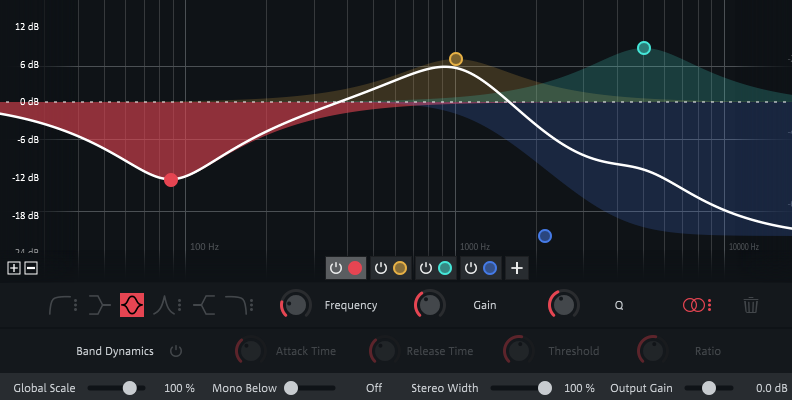
A traditional EQ consists of a few controls to set the filter type (band, shelf, notch, high-pass, or low-pass), the bandwidth (Q), and the gain to adjust the boost or cut at the selected frequency or dynamic range. A dynamic EQ has all of these controls, plus dynamic options such as threshold, attack and release times, and ratio, as found in compressors and expanders.
Another way to think about a dynamic EQ is as a combination of traditional EQ and a compressor or expander. In a traditional EQ, the gain is fixed for each band, whereas a dynamic EQ varies the gain in proportion to the input signal's intensity. It means you can cut or boost frequencies at different intensities throughout the track.
What Does Dynamic EQ Do?
A dynamic EQ is an EQ that automatically boosts or cuts frequencies based on the level of the input audio signal. In other words, EQ dynamic processing activates only when the threshold is reached, unlike traditional EQ, which is always active on the track or clip where it is applied.
Let’s see an example. Sometimes you want to reduce vocal harshness in your main vocal track. You identify the troublesome frequencies and add an EQ, but then you notice that those frequencies are only problematic during the chorus, where the singer is singing louder. Now that the EQ is active, the rest of the track is being affected by this change.
In the past, you only had a few options: leave the harshness as is or accept the rest of the track being affected by the EQ. Now, thanks to dynamic EQs, you can only equalize when those frequencies are stronger. It also addresses resonances, bass boom, and other issues, while shaping your sound more precisely and creatively to make your mix sound as good as possible.
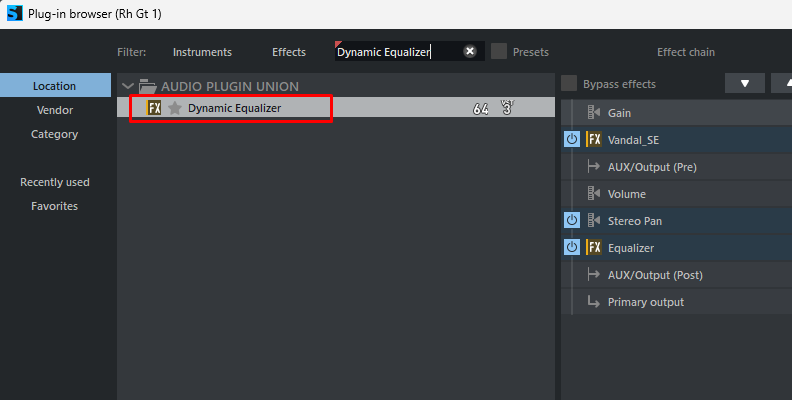
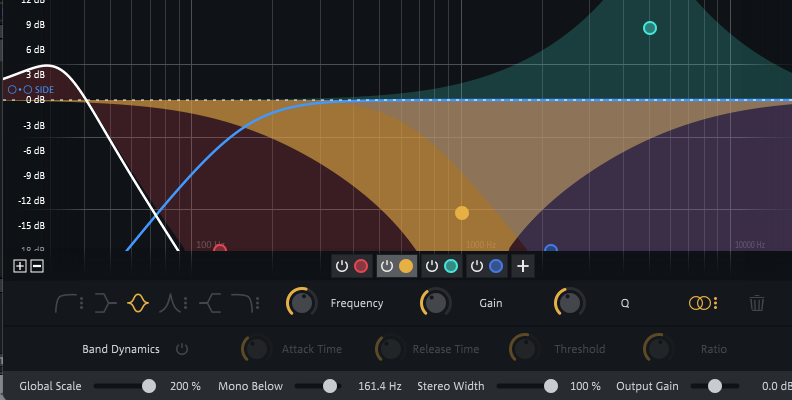
In Samplitude, the dynamic EQ plugin includes the usual band- and filter-type options and parameters, as well as specific frequency band controls.
- Attack/Release determines how quickly the EQ reacts to level changes.
- Threshold sets the level at which the band dynamics affect the gain.
- The ratio determines the direction and magnitude of the gain correction. Ratio values below 1 (negative values) result in expansion, boosting the selected frequencies, and values over 1 (positive values) result in compression, cutting the selected frequencies.
How Dynamic EQ Works In A Mix
There are several reasons why you would use a dynamic EQ on your mix in general, and why you would use it instead of a traditional parametric EQ. In the following section, I break down the main reasons to use a dynamic EQ in your mixing process.
Fix Occasional Issues
With traditional mixing, fixing one issue can introduce others. For example, removing low-end muddiness can reduce warmth in other sections of the song. Using a dynamic EQ solves this problem by cutting the mud only during sections of the song where it is overwhelming, while preserving the warmth where you want it.
Precise Boost Control
Dynamic EQ grants you more control when you want to boost frequencies to add more presence or air to your mix. Since you only boost when these frequencies reach a specific level, you’ll avoid adding more harshness or sibilance where you don't want it. It also works well when boosting mid- and low frequencies to add warmth without sounding muddy.
Resonance Control
During your mix, you may catch some pesky resonances ringing out on specific notes of a guitar or vocal line. A dynamic EQ can give you more control to tame these out-of-control resonances. A good way to achieve this is to set a narrow notch filter in your dynamic EQ plugin to trigger only on the problematic notes. This way, you’ll have that resonance under control and avoid hollowing your entire sound just to fix one rogue frequency.
Accentuate Transients
If you are listening to your mix and find that some instruments lack “punch,” a dynamic EQ lets you target the specific frequencies of a kick's “click” or a snare's “crack” to highlight them in the mix. In this case, the dynamic EQ will operate in expansion mode, boosting the snare’s “attack” frequency to create a sharper and more defined transient that cuts through your guitars and synths, but the EQ will deactivate during the sustain to prevent harshness.
Instrument Separation
You can keep your instruments clear from each other with the help of a dynamic EQ. Often, mixer engineers use sidechain compression to solve this separation issue, but your mix may lack transparency. A dynamic EQ makes this easier than sidechaining instruments by setting a cut on the frequencies where the instruments clash. You can add the dynamic EQ to a single instrument or to a group of instruments in a bus track to achieve a more transparent separation.
Better Sidechain
As a follow-up to the previous reason, dynamic EQ can be used for sidechaining or “ducking.” With sidechaining, you duck the entire track of an instrument, creating the “pumping” effect people enjoy in electronic music. However, when you don’t want your kick drum pumping during the entire song, a dynamic EQ will allow you to cut the frequencies during those passages without the distracting pumping effect playing the whole time.
Transparent De-Essing
Another creative way to use a dynamic EQ is as a de-esser. Using a de-esser or multiband compressor to tame the harsh S and T sounds in a vocal track can introduce artifacts. The dynamic EQ offers surgical precision on the unwanted frequencies so you can preserve the voice’s brightness.
Streamline Workflow
As you may notice, a reason for using a dynamic EQ in your mixes is to achieve better or cleaner results than other tools, processes, or techniques, such as compression, de-essing, sidechaining, etc. While you may get similar results, dynamic EQ can streamline your workflow by performing the same tasks more efficiently. This may be subjective, and you may prefer using other tools for certain scenarios. Like any tool, dynamic EQ helps you work efficiently.
Main Difference Between Dynamic EQ vs Multiband Compressor
A common question about dynamic EQ is how it differs from a multiband compressor. Truth is, they’re both similar as they both address problems of frequency-specific volume control, but with key differences about where you are focusing, whether it is a frequency issue, volume-dependent, or a dynamic issue within a broad frequency range. I break down this difference by feature to better understand it.
Filter Type
- A dynamic EQ uses more surgical filters, such as bell, shelf, and notch filters.
- A multiband compressor uses broader crossover filters, such as a high-pass and a low-pass, to split the signal.
Transparency
- Signal integrity is higher with a dynamic EQ because it only affects the signal when the threshold is crossed.
- The multiband compressor may have lower transparency due to splitting the signal into bands, which can introduce coloration even when it’s not compressing.
Phase Shift
- Phase shifting can occur only when the filter is active.
- Multiband compression can introduce phase shifts and artifacts constantly at the crossover points.
Control Style
- Dynamic EQ provides finer control over Gain (dB) and Bandwidth (Q) to delimit the affected area.
- Multiband compression focuses on timing defined by the Ratio, Attack, and Release controls.
Bands
- With a dynamic EQ, you can define very narrow bands or an overlap band.
- Multiband compression only bands that are fixed side by side and cannot overlap.
Final Words
Dynamic EQ is a versatile tool for audio processing. It can help you shape your sound, fix frequency issues with surgical precision, boost and cut with surgical precision, tame resonances, prevent instrument masking, and emphasize transients to produce better-sounding mixes.
If you’re still struggling to find the difference between a multiband compression, think of them as this: a dynamic EQ as an equalizer that behaves like a compressor, and a multiband compressor like a compressor that behaves like an EQ. Use a dynamic EQ as a scalpel to fix frequency problems at specific levels, and a multiband compressor as a sledgehammer to fix problems across a broad frequency range.

You can experiment with Dynamic EQ in your mixes and use what you’ve learned in this article with a Samplitude trial. Samplitude’s dynamic EQ is intuitive, with flexible filter types, easy-to-use controls, and presets that let you make targeted adjustments to audio tracks and virtual instruments.
Good luck!
FAQ
Should Dynamic EQ Be On or Off?
When mixing music, there is no one setting that suits all projects. Enabling a dynamic EQ instead of static EQ adjustments, multiband compression, or other tools depends entirely on the audio signal and the issue you are trying to address. Follow these next points as guidelines, but try for yourself and explore different use cases. Remember that music production is all about creativity.
Keep dynamic EQ on:
- For intermittent problems.
- Precise adjustments.
- Preserve the sound's presence and life after cleanup.
- Tame resonance.
- Highlight specific sounds at specific levels.
- More transparent instrument separation.
Keep dynamic EQ off:
- For constant tonal correction and tonal shaping.
- Intentional coloration to add warmth and character.
- To work with a broader frequency spectrum.
- For simple high/low passes.